Kobyz
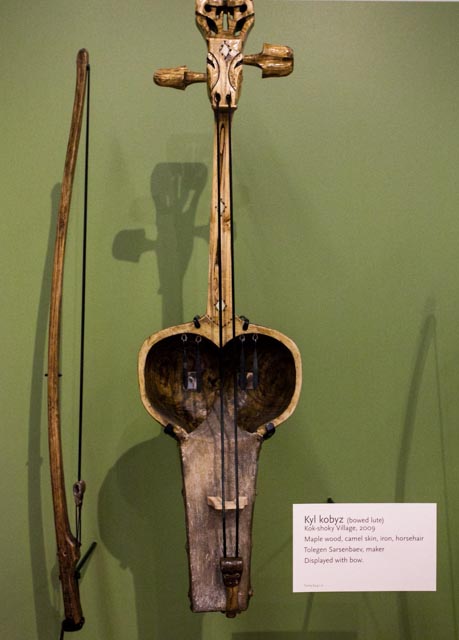
The Kobyz — Mystic Sounds of the Steppe
The Kobyz (or Qyl-kobyz) is an ancient, sacred two-stringed bowed instrument of the Kazakh people. Historically, it was not merely a musical instrument, but a shamanic ritual object used by spiritual healers (Baqsy) for ceremonies, meditation, and storytelling.
1. Legend and Origins
The creation of the Kobyz is linked to the legendary philosopher and bard, Korkut Ata. According to myth, Korkut traveled the world trying to escape death. Realizing death was inescapable everywhere, he hollowed out a piece of wood and crafted the first Kobyz. Its resonant sound suspended time and held death at bay. Thus, the Kobyz symbolizes immortality through music.
2. Anatomy and Craftsmanship
The Kobyz possesses an extraordinary acoustic architecture:
- Hollowed Body: The entire frame is carved out of a single solid piece of wood (maple or birch). The upper soundbox remains open, while the lower half is covered with dried camel skin acting as a membrane.
- Horsehair Strings: Both strings and the bow are made exclusively from unspun strands of horsehair (30-60 hairs per string), imparting a rich, guttural, human-like timbre.
- Fretless Fingering Technique: Unlike Western bowed instruments, musicians do not press the strings onto a fingerboard. Instead, they touch the side of the strings using their fingernails, producing ethereal microtones and harmonics.
3. Cultural Legacy
The sound of the Kobyz mimics the rustling wind, the cry of wolves, and human chanting, making it one of the most expressive string instruments in Central Asia.